|
(30/10/2014)
This system facilitates fast access to metro stations, making it possible to have a station entrance at less than 500 metres from any commuter, attracting up to 30% additional passengers. It also allows transport authorities to build passenger feeders to existing metro stations, thus improving connectivity and efficiency of metro networks in cities.
ACCEL is capable of carrying 7,300 passengers per hour per direction and reaching a maximum speed of over 10 km/h, offering comfort and safety. It allows commuters to reduce their travel times, has no waiting times and does not require any entry barriers.
Although the system looks like a conventional walkway, passengers use it as a simple continuation of walking but just much faster and with no effort.
ACCEL has been developed on the basis of the technology of the magnetic train Transrapid, project in which Thyssen, Siemens, Lufthansa and German Railways (DB) participated and whose economic feasibility prospects led it to abandonment.
The ACCEL system
ACCEL is a moving walkway designed to cover distances of up to 1.5 km in modules from 100 to 500 metres. Offering high capacity and high speed for short distances, this solution can transport as many passengers as typical fully automated cabin systems, which makes it a competitive alternative with lower implementation costs.
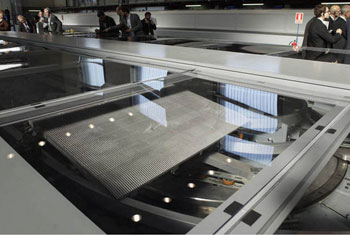
Using a band of overlapping pallets that expand to three times the original size of each pallet, ACCEL’s technology ensures that passengers step onto the belt at normal walking speeds of 0.65 m/s (2.35 km/h), accelerate smoothly up to 2 m/s (7.2 km/h) in the middle section, and then decelerate back to normal walking speeds before leaving the system. For passengers who continue walking while on the belt, speeds of up to 3.3 m/s (12 km/h) can also be achieved with consistently high and safe travelling comfort.
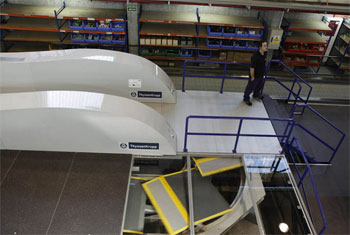
The band actually forms a circuit and the pallets return via the opposite lane. The bends are invisible as they are located below the floor surface, which is how ACCEL achieves its small construction depth of only one metre – similar to conventional walkways.
How does it work?
Composed of a band of pallets, which appear similar to a regular moving walkway, ACCEL incorporates game-changing technology beneath the surface. The band is built using the overlapping pallet concept that expands to the original size of each pallet by three times. Each aluminium pallet consists of two parts and at the start of the walkway they are laid closely one over the other. As the speed increases they push apart, before coming together again near the end.
Each pallet is equipped with its own magnet propelled by linear motors installed in fixed positions. In addition, the pallet band and the handrail are two separate systems that run precisely in sync, and sensors constantly focus on the position of the individual grips and pallets, ensuring that passengers always feel that these are moving at the same speed, experiencing a smooth and safe ride.
The linear motors and encoders are perfectly synchronized by the control system and are a further development of the magnetic train Transrapid, where the motors are especially low-vibration and low-maintenance. However, if a motor does occasionally fail, the mechanical safety chain engages and pulls the pallet via a dragger, ensuring continuity of operations.
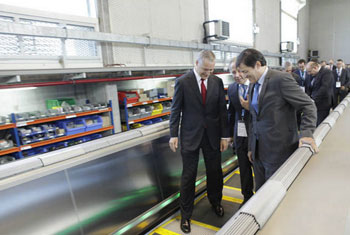
ThyssenKrupp Elevator has over 50,000 employees worldwide, of whom 10% work in Spain, where the company owns three manufacturing plants, in Madrid and Asturias. The ACCEL system was developed and tested by the ThyssenKrupp R&D&I Centre in Gijon, Asturias.
|
El Express Walkway 'Turbo Track' en el aeropuerto Pearson de Toronto. Canadá
|
|