|
(13/07/2012)
Consortium and funding
The project budget initially amounted to €2,567,367 through funding from the Spanish Ministry of Science and Innovation, having Adif as owner entity and project leader, and is also user together with Metro de Madrid. Later on, with the prolongation of the project and the increase of its budget, the following technological centres, companies and final users have been part of it: Ciemat, Green Power Tech. Adif, Tekniker, Elytt Energy, Iberdrola, University of Seville, Imdea Energía, Zigor, Inabensa and Acciona.
Project description
Given high energy costs, the SA2VE project aims to use the braking energy of trains, which is not used by other trains on the network and therefore is dissipated in braking resistances. This energy could reach values of up to 20% of energy consumed. The consumption profile of a substation is characterized by its irregularity with continuous peaks and valleys that correspond to the presence or absence of traffic. This is a not desirable situation because peaks are forcing to oversize transformers and other substations equipment for a reduced utilization in a moment.
In addition, power companies penalize the presence of these peaks because it also requires them to oversize their facilities. In this situation, the energy storage system delivers power during peaks demand from the energy stored in the valleys. This makes a more uniform consumption profile, reducing substation elements and supply penalties. While this system can be applied in high-speed network to eliminate the consumption peaks, the system that Adif is developing will be applied to the conventional network, in which energy cannot be returned to the network because current substations consist of diode-based rectifiers and therefore are not reversible.
The advantages to be derived from this project can be summarized as follow:
• Reduction of losses in energy conversion and transport to trains
• Use of the braking energy of trains
• Energy efficiency of railway facilities
• Improved stability of the electrical network
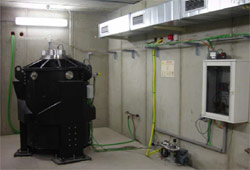
Under this situation, a storage system has been designed and built for the kinetic energy that comes from braking trains (KESS, Kinetic Energy Storage System). In developing this system several prototypes have been built that have culminated in the prototype Omega (W), capable of storing 200 MJ of energy and transferring it to a power of 500 kW, becoming the largest kinetic energy storage system within the world. The system consists of three basic components:
1. Flywheel of 6 tm weight and spinning up to 6000 rpm. Levitates by a crown of permanent magnets and works at vacuum atmosphere to minimize mechanical losses.
2. Motor/generator of switched variable reluctance that is responsible for transferring electrical energy into kinetic energy (motor mode) or kinetic energy into mechanical one (generator mode).
3. DC-DC/AC dual specific electronic converter for variable reluctance machine that transforms the catenary’s continuous voltage of 3 kV into 750 V and from this into the AC voltage required by the machine. It is noteworthy that both the complete design and manufacturing of different prototypes and W final prototype have been developed entirely by the project partners, constituting a milestone of great importance in boosting the national technology. The machine bearings are the only elements of foreign manufacture (Holland).
Project status and evolution
Once initiated tests in 2007, significant progress has been made in areas such as increased ability to withstand heat, an improvement in response to critical frequencies or noise reduction. The new prototype tests have been performed in two stages:
• During 2009, laboratory tests with catenary simulators at 3 kV.
• In 2010, tests in the Cerro Negro substation that is being adapted for this purpose in what shall be known as Railway Traction Technologies Testing Center (CETRAFF in Spanish) in order to test the storage system.
Related to SA2VE development for Adif lines, a storage system that will be installed in a vehicle of Metro de Madrid is also being developed, as differentiated application of the system and for rolling stock.
To summarize it can be said that the storage system is a complementary system to return energy to the grid (this implies money savings). Furthermore, storage systems not only save energy but also have advantages for the infrastructure (low voltage areas).
The project next steps would be to continue testing in 2012, to optimize the development and to analyze where to install Storage Systems or Reversible DC Substations.
For further information: www.sa2ve.es
|