|
(14/05/2012)
Project highlights
Innovation in railway infrastructure has been developed along mutually exclusive paths either with ballasted track or slab track. Until now, no intermediate solution has been investigated where materials and advanced simulation tools would allow the research, development and manufacturing of an “artificial ballast”, as a new approach which should eventually combine the advantages of crushed-rock or natural ballast with the controlled design, manufacturing and construction features that characterize slab track.
Project description
The “Artificial Ballast” idea comes from a concept which has been used in other fields of civil engineering and construction, i.e. the progressive substitution of natural materials by artificial materials with improved features and longer life cycles. This project is the first step towards research into an artificial material that may be used in the medium term for construction of new railway lines or renovation of existing lines.
The project has been involving different perspectives and fields of expertise. On one hand, the research is focusing on finding suitable base materials for artificial ballast manufacturing, with focus on developing micro-concrete or high resistance mortars, with cement base and different additives. On the other hand, mass-production techniques are being investigated (casting, controlled crushing of base material,…), with alternatives for texture, roughness or indentations. At the same time, computer models are being developed to further define the geometric properties of grains that should lead to an improvement in the behaviour of the ballast layer.
The test program of the project intends to establish a rigorous comparison between natural (from three selected quarries) and artificial materials, considering different behaviour parameters.
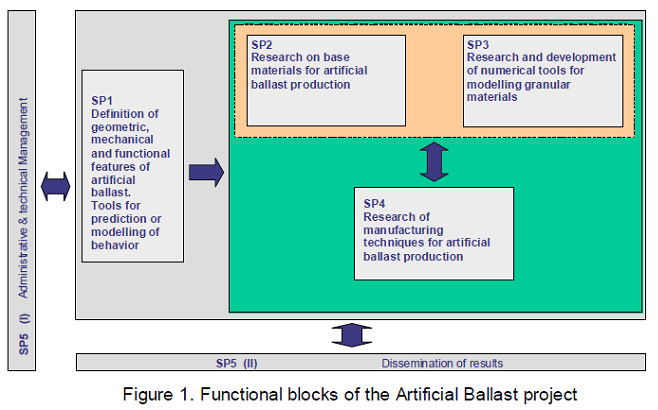
The methodology used to develop the project unfolds ‘Artificial Ballast’ in 5 sub-projects that are structured as shown in figure 1 and interact with each other.
SP1. Definition of geometric, mechanical and functional features of artificial ballast. Tools for prediction or modelling of behaviour.
SP2. Research on base materials for artificial ballast production.
SP3. Research and development of numerical tools for modelling granular materials.
SP4. Research on manufacturing techniques for artificial ballast production.
SP5. Technical management, administration and dissemination of the project results.
 |
The project will assess the feasibility of different industrial production techniques of artificial ballast grains, mainly along the following options:
- Grain moulding, with particle geometry allowing an easy mould release.
- Crushing of blocks of artificial material with preferred fracture planes.
- Controlled “dilatation” breakage of blocks of artificial material.
The curing techniques of ballast particles will also be analyzed.
Relevant characteristics and benefits of the project:
- Pioneer experience in the development of new material for railway applications.
- Improve the knowledge of the behaviour of natural ballast, widely used in railways, but on which there are still many uncertainties about its behaviour and degradation.
- Obtain environmental benefits deriving from the possibility of using residue in its fabrication and the reduction of the volume of rock to be extracted from natural quarries.
- Study of new materials that can be used in the production of artificial ballast and its adaptability to be used in the improvement of new lines with the existing maintenance processes and techniques.
Project participants
Artificial Ballast is funded by the Spanish Administration within the Multi-year Plan of Research, Development and Technology Innovation 2008-2011, and should be the first step toward further investigation into related matters. The project, which is currently under development, is led by Fundación Caminos de Hierro (FCH) and includes the involvement of important Spanish partners: the Polytechnic University of Madrid (UPM), INGECIBER, Oficemen, IECA and the Spanish Railways Foundation (FFE).
|